
A Miracle in Minutes
Posted: Aug 16, 2026

For the Forst-Vaughn family, an ordinary summer afternoon became a powerful reminder of just how much can change in a matter of seconds—and how important it is to have lifesaving emergency care close to home.
On June 13, Haley Forst and her husband, Jordan, were spending the afternoon with their children, Baylee and Brayden, at the children’s grandparents’ home in Pace. The family had been enjoying time together around the swimming pool when 3-year-old Baylee slipped into the water while reaching for a toy.
Baylee had taken Infant Rescue Swimming lessons and knew how to use a float in the water. This time, however, she inhaled too much water and was unable to recover.
When Haley pulled her daughter from the pool, Baylee was limp and turning blue.
Jordan immediately began CPR. After several critical minutes, Baylee began expelling water, but she remained unresponsive. Knowing his daughter needed emergency care immediately, Jordan picked her up and rushed to the nearby Ascension Sacred Heart Emergency Department in Pace.
The facility had opened its doors less than two months earlier.
As soon as Baylee arrived, the emergency department team moved quickly.
Dr. Christopher Valle, the attending emergency physician that afternoon, and the clinical team began working to stabilize Baylee. Her oxygen level was dangerously low, and the amount of water she had inhaled put her in a critical condition.
The team administered oxygen, established an IV and connected Baylee to monitors while a respiratory therapist worked to remove fluid from her lungs. The staff’s experience caring for critically ill and injured patients allowed them to respond rapidly and coordinate the next steps in her care.
Valle emphasized that Jordan’s decision to begin CPR immediately was also vital. In a drowning emergency, every minute without adequate oxygen can have serious consequences for the brain and other organs. The combination of immediate CPR and rapid access to emergency medical care gave Baylee an important advantage when seconds mattered.
For charge nurse Sara Carroll, RN, the response felt much longer than it actually was. When she later reviewed the timeline recorded by the monitors, she realized only about four or five minutes had passed between the team getting Baylee connected to the monitor and the decision to initiate her transfer for additional pediatric care.
“Our team did what our team does best,” Carroll said.
Once she was stabilized, Baylee was transferred to Studer Children’s Hospital for continued care. Just a few days later, she was able to go home with her family in good health.
Emergency caregivers are often there for patients during some of the most frightening moments of their lives, but they do not always have the opportunity to see what happens after a patient leaves their care.
Baylee gave the Pace emergency team that opportunity.
Weeks after the accident—and after celebrating her fourth birthday—Baylee returned to the emergency department with her family to visit the people who had cared for her. This time, instead of being carried through the doors in an emergency, she came running in.
When she saw Carroll, Baylee greeted her with a hug.
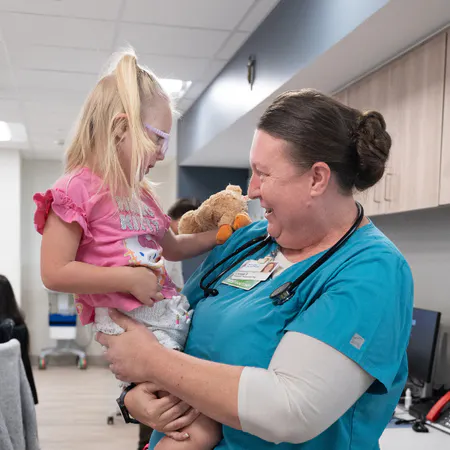
For Carroll, a registered nurse with more than two decades of experience, the reunion was especially meaningful. “To see her come running in that door and for her to run up and give me a hug, it’s everything,” Carroll said. “It’s what keeps me coming back to this job.”
The moment also reinforced something the team already understood: having emergency services available nearby can make an extraordinary difference. “Had we not been here, this outcome could have been so different,” Carroll said.
Ascension Sacred Heart Emergency Department in Pace had been serving the community for less than two months when Baylee’s accident occurred. For her family, its location meant that advanced emergency care was only moments away when they needed it most.
Haley said she often thinks about how differently the day might have ended if the family had needed to wait longer for help or travel farther for emergency treatment. “I’m just so blessed this place was here at the time,” she said. “This place was really a godsend.”
Baylee’s recovery is particularly meaningful given the medical challenges she had already overcome in her young life. Before she was born, she was diagnosed with congenital diaphragmatic hernia, a rare condition in which the diaphragm does not develop properly, allowing abdominal organs to move into the chest and affect lung development.
Baylee underwent surgery when she was just three days old to repair her diaphragm. Although her family initially expected a hospitalization lasting six to eight months, she was able to go home after approximately three and a half months. She also faced heart complications, including two holes in her heart. One closed on its own, while another required surgery after her first birthday.
Today, Baylee continues to receive follow-up care, but her mother describes her as energetic, fearless and full of personality—a little girl who has repeatedly demonstrated her resilience. “She’s a true fighter,” Haley said.
Baylee’s story demonstrates why access to emergency care close to home matters. A family’s worst moment can happen without warning, and when it does, the distance between a patient and skilled emergency care can become critically important.
The Ascension Sacred Heart Emergency Department in Pace was created to bring that care closer to the growing community. For families like Baylee’s, its presence means experienced physicians, nurses, respiratory therapists and other caregivers are ready to respond when minutes—and sometimes seconds—matter most.
Through the support of generous donors and community partners, Sacred Heart continues to invest in the facilities, technology, and people needed to provide compassionate, lifesaving care where it’s needed.
For Baylee’s family, that mission is no longer an abstract idea. It is something they experienced firsthand.
And for the team who watched a healthy 4-year-old run back through the emergency department doors weeks later, it is a reminder of what those investments can mean: more time, more birthdays, more hugs and more moments together.